

.png)
.png)


ISO EN standards specifications
Footwear for professional use is divided into 3 groups according to standards:
"O" | CSN ISO EN 20347 |
The standard specifies work shoes for professional use, which are designated by the letter "O". The basic parameter of work shoes is that they do not have a built-in steel toe cap. | |
We further divide work shoes into the following categories: | |
O | the footwear meets only the basic requirements |
O1 | antistatic properties, sole resistance to fuels, energy absorption of the heel part |
O2 | same as O1 + water penetration and absorption |
O3 | same as O2 + puncture resistance |
"P" | CSN ISO EN 20346 |
The standard specifies protective footwear for professional use, which is designated by the letter "P". The basic parameter of protective footwear is a built-in steel toecap resistant to 100J impact. | |
We further divide protective footwear into the following categories: | |
PB | the footwear meets only the basic requirements |
P1 | antistatic properties, sole resistance to fuels, energy absorption of the heel part |
P2 | same as P1 + water penetration and absorption |
P3 | same as P2 + puncture resistance |
"WITH" | CSN ISO EN 20345 |
It specifies safety footwear for professional use, which is designated by the letter "S". The basic parameter of safety footwear is a built-in steel toecap resistant to 200J impact. | |
We further divide safety footwear into the following categories: | |
SB | the footwear meets only the basic requirements |
S1 | antistatic properties, sole resistance to fuels, energy absorption of the heel part |
S2 | same as S1 + water penetration and absorption |
S3 |
same as S2 + puncture resistance |
S4 | as with S2 for footwear, they consist exclusively of rubber (vulcanized) or polymers (sprayed) |
S5 | as with S3 for footwear, they consist exclusively of rubber (vulcanized) or polymers (sprayed) |
The values of the requirements that footwear for professional use must meet are specified in the ČSN ISO EN 20344 standard.
Symbols of additional and special requirements used in footwear specifications:
AND | Antistatic shoes |
E | Energy absorption in the heel |
P | Puncture resistance |
WHOSE | Cold resistance |
HI | Thermal resistance of the bottom of the shoe |
FO | Footwear resistance to fuels and oils |
MRO | Sole resistance to contact heat up to 300°C |
WRU | Resistance to water penetration and water absorption |
EN20381/1-3 | Chainsaw cut protection |
SRA | Slip resistance of the sole |
SRC | Slip resistance of the sole |
WR | Resistance to water penetration |
F | Firefighter protective footwear |
FP | Firefighter safety shoes, puncture resistant sole |
FA | Firefighter protective footwear, antistatic |
FPA | Firefighter safety shoes, puncture resistant sole, antistatic |
CR | Shoe upper cut protection |
M | Instep protection against impact |
"F" | EN 15090:2012 |
Shoe marking: |
|
F1 | External impacts without the need for sole puncture protection, toe protection or chemical protection |
F2 | Firefighting and rescue operations with puncture protection sole and protective toe cap, without chemical protection |
F3 | Firefighting and rescue operations with puncture protection sole and protective toe cap, with chemical protection |
Added features if not listed in the type: | |
HI | heat insulation |
P | penetration |
T | protective toe |
R | solid toe protection |
AND | electrical insulation |
AND | antistatic |
WHOSE | cold resistance |
CH | chemical resistance |
M | instep protection |
AN | ankle protection |
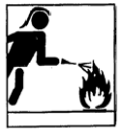
| pictogram with classification of suitable footwear for firefighters |
F1 | mandatory F1 |
F1A | = F1 plus antistatic |
F1AP | = F1A plus penetration resistance |
F1I | = F1 plus electrical insulation |
F1PI | = F1I plus penetration resistance |
F2 | mandatory F2 |
F2A | = F2 plus antistatic |
F2I | = F2 plus electrical insulation |
mandatory F3 | |
F3A | = F3 plus antistatic |
F3I | = F3 plus electrical insulation |